About us
Since 1985, the Frugivory and Seed Dispersal Symposia have contributed to advancing our understanding of this ecological interaction, which is fundamental to terrestrial ecosystems. Conceived after the VIII Frugivory and Seed Dispersal Symposium, held in Ilhéus in 2024, and established in 2025, the DISPERSE Network aims to contribute to this ongoing development. DISPERSE is an interinstitutional network on frugivory and seed dispersal based at UESC in Ilhéus, Brazil.
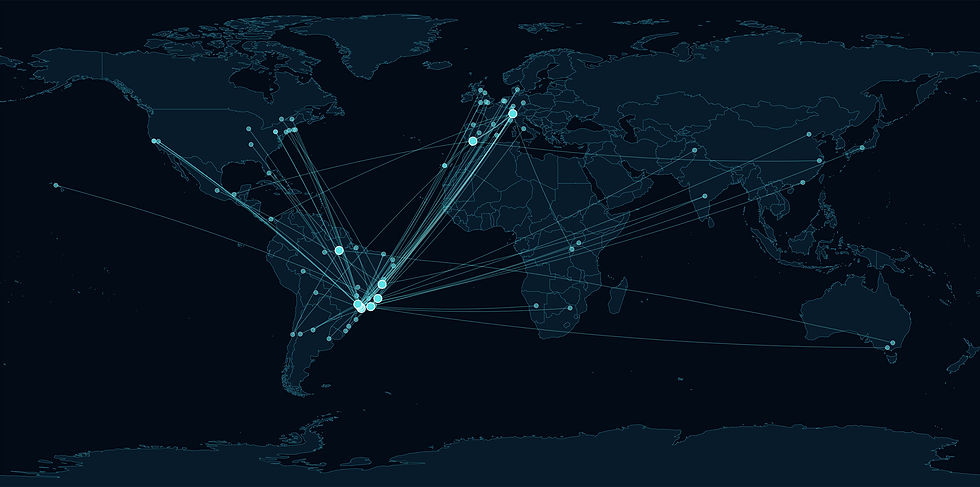
In addition to our collaborative work, the DISPERSE network is connected to scientists from different institutions around the globe, helping to deepen our understanding of the patterns and processes that generate, organize, sustain, and threaten biodiversity.

Alexandra Pires


Department of Environmental Sciences, Federal Rural University of Rio de Janeiro (UFRRJ)
Alexandra Pires studies the loss of ecological interactions and the effects of defaunation and forest fragmentation on Atlantic Forest biodiversity.
Her research investigates mammalian movement, predation, and seed dispersal, as well as the restoration of ecological processes through fauna reintroduction.
She seeks to understand and restore ecological interactions that are essential for the maintenance and recovery of tropical ecosystems.

Caroline Dracxler

Federal University of Rio de Janeiro (UFRJ)
Caroline Dracxler studies the ecology and evolution of plant–animal interactions, with a focus on the mutualism–antagonism continuum in systems involving palms, frugivores, and parasitoids.
Her research investigates how traits related to seed dispersal, predation, and parasitism influence plant recruitment, population dynamics, and the vulnerability of tropical species.
She integrates macroecology, coevolution, and conceptual syntheses to understand the mechanisms that structure biotic interactions in tropical forests.

Lucas Gonçalves
National Institute of the Atlantic Forest (MCTI-INMA)
Lucas Gonçalves studies the ecology and evolution of Brazilian fauna, with a focus on ecological modeling, biogeography, and evolutionary processes applied to the conservation of endangered species.
His research investigates spatial patterns of polymorphic phenotypes, historical distribution, and population viability in mammals, integrating macroecological, genetic, and demographic analyses.
His work aims to understand the impacts of human activities on biodiversity and to support public policies for wildlife conservation in Brazil.

Mathias M. Pires
Department of Animal Biology, Unicamp
Mathias M. Pires studies the reorganization of ecological systems in response to biodiversity loss.
His research uses ecological network approaches, mathematical modeling, and computer simulations to investigate indirect effects, extinctions, and changes in trophic and mutualistic interactions.
He seeks to understand how these changes affect ecosystem functioning and ecological and evolutionary patterns across different spatial and temporal scales.

Paula Lemos da Costa
Department of Ecology, Institute of Biosciences, USP
Paula Lemos da Costa studies the structure and dynamics of ecological communities from an evolutionary perspective, with a focus on coevolution and context-dependent interactions.
Her research investigates how gene flow, phylogeny, and spatial organization influence the dynamics of ecological interactions and the emergent patterns of ecological networks.
Her work integrates theoretical modeling, experiments, and network analysis to understand the organization and stability of complex communities.

Rita de Cássia Portela

Federal University of Rio de Janeiro (UFRJ)
Rita de Cássia Portela studies plant population dynamics in fragmented Atlantic Forest landscapes, with a focus on palms and forest regeneration.
Her research investigates the effects of fragmentation and defaunation on recruitment, seedling mortality, and ecological cascades that influence the structure of plant communities.
Her work integrates plant demography, biodiversity conservation, and tropical forest ecology.

Ana Paula A. Assis
Department of Genetics and Evolutionary Biology, University of São Paulo (USP)
Ana Paula A. Assis studies evolution and coevolution in biological systems, integrating quantitative genetics, morphology, and ecological networks.
Her research investigates how genetic correlations, natural selection, and mutualistic interactions shape species adaptation and evolutionary dynamics across different environmental contexts.
She explores the connections between microevolutionary processes, climate change, and ecological network structure to better understand the evolution of biological diversity.

Débora Rother
Centro de Ciências da Natureza, Universidade Federal de São Carlos (UFSCar), São Carlos, SP
Debora Rother studies ecological conservation and restoration in tropical landscapes, with a focus on seed dispersal, forest regeneration, and ecological networks.
Her research investigates how plant–frugivore interactions, landscape structure, and nature-based solutions influence biodiversity recovery and the provision of ecosystem services.
She integrates community ecology, forest restoration, and network analysis to promote multifunctional and sustainable landscapes.

Marco Aurélio Pizo
Department of Biodiversity, São Paulo State University (UNESP), Rio Claro, SP
Marco Aurélio Pizo studies the ecology of plant–frugivore interactions, with a focus on seed dispersal and the mechanisms of specialization between birds and plants.
His research investigates how fruit selection by frugivores acts as a biotic filter influencing forest regeneration and community composition, including its implications for carbon capture and storage.
His work integrates behavioral ecology, mutualistic networks, and biodiversity conservation in fragmented tropical landscapes.

Mauro Galetti
Department of Biodiversity, São Paulo State University (UNESP), Rio Claro, SP
Mauro Galetti studies defaunation and its ecological and evolutionary impacts in the Anthropocene, with a focus on the loss of large vertebrates and its consequences for ecosystem functioning.
His research investigates how species extinctions alter processes such as seed dispersal, forest dynamics, and biogeochemical cycles, integrating interaction ecology and biodiversity conservation.
His work aims to understand ecological responses to biodiversity loss and to guide conservation strategies in the face of global environmental change.

Paulo R. Guimarães Jr.
Coordenador
Department of Ecology, Institute of Biosciences, USP
Paulo R. Guimarães Jr. studies the interface between ecology, evolution, and network theory, investigating the structure, dynamics, and stability of ecological networks, especially mutualistic networks between animals and plants.
His work integrates mathematical modeling and complex systems theory to understand coevolution, indirect effects, and the consequences of human impact for the organization of ecological interactions.
His research seeks to understand how structural patterns emerge in ecological networks and how these patterns influence ecology, evolution and the persistence of biodiversity.

Rodrigo Ferreira Fadini
Institute of Biodiversity and Forests (IBEF), Federal University of Western Pará (UFOPA)
Rodrigo Ferreira Fadini studies the ecology of plant–animal interactions in the Amazon, with a focus on seed dispersal, defaunation, and forest regeneration.
His research particularly investigates the ecology of mistletoes (Loranthaceae), including patterns of parasitism, pollination, and population dynamics in savannas and Amazonian forests.
His work integrates conservation biology, ecological interactions, and the role of vertebrates in the maintenance and restoration of tropical ecosystems.

Carolina Bello
Department of Environmental Systems Science, ETH Zürich, Switzerland
Carolina Bello studies the contribution of fauna to ecosystem functioning and the potential for carbon restoration in fragmented landscapes.
Her research investigates how seed dispersers, trophic networks, and ecological interactions influence biodiversity recovery and climate change mitigation, integrating ecological modeling and environmental DNA (iDNA).
She connects functional biodiversity, process-based restoration, and environmental health from a global perspective.

Eliana Cazetta
Coordenadora
eliana.cazetta@gmail.com
Department of Biological Sciences, State University of Santa Cruz (UESC), Ilhéus, BA
Eliana Cazetta studies the ecology of plant–frugivore interactions and the effects of fragmentation and deforestation on seed dispersal and the functioning of tropical ecosystems.
Her research investigates how the spatial configuration of human-modified landscapes influences dispersal networks, functional diversity, and plant establishment in the Atlantic Forest.
Her work integrates ecological network analysis, global meta-analyses, and biodiversity conservation in tropical biodiversity hotspots.
Marina Corrêa Côrtes
Department of Biodiversity, São Paulo State University (UNESP), Rio Claro, SP
Marina Corrêa Côrtes studies spatial genetics and ecological interactions, with a focus on seed dispersal and the role of frugivorous birds in shaping the genetic structure of plant populations.
Her research investigates how forest fragmentation, environmental heterogeneity, and fauna loss influence genetic patterns, gene flow, and regeneration in tropical forests.
Her work integrates landscape genetics, interaction ecology, and conservation biology to understand the ecological and evolutionary effects of environmental change.

Patricia Morellato
Department of Biodiversity (formerly Botany), São Paulo State University (UNESP), Rio Claro, SP, Brazil
Patricia Morellato studies the phenology of tropical plants and the impacts of climate change on seasonal patterns of flowering, fruiting, and ecosystem dynamics.
Her research investigates how climate variability and extreme events affect plant–pollinator and plant–disperser interactions, integrating long-term monitoring, ecological networks, and new technologies such as phenocams and remote sensors.
Her work connects phenology, biodiversity, and conservation, with a focus on the responses of tropical biomes to global environmental change.

Pedro Jordano
Estación Biológica de Doñana, Spanish Council for Scientific Research (CSIC), Sevilla, Spain
Pedro Jordano studies biodiversity from ecological and evolutionary perspectives, with a focus on plant–animal interactions and mutualistic networks.
His research investigates how ecological interactions structure complex systems, using network analysis to understand the patterns, functions, and consequences of mutualisms in maintaining biodiversity.
He has developed innovative molecular approaches to track seed dispersal and gene flow, contributing to conceptual and methodological advances in the study of coevolution and ecological connectivity.
ASSOCIATED INSTITUTIONS AND FUNDING